Semester
Subject
Year
Tribhuwan University
Institute of Science and Technology
2079
Bachelor Level / First Year / First Semester / Science
Bachelors in Information Technology (MTH104)
(Basic Mathematics)
Full Marks: 60
Pass Marks: 24
Time: 3 Hours
Candidates are required to give their answers in their own words as for as practicable.
The figures in the margin indicate full marks.
Section A
Long Answers Questions
Attempt any TWO questions.
[2*10=20]
Main Question
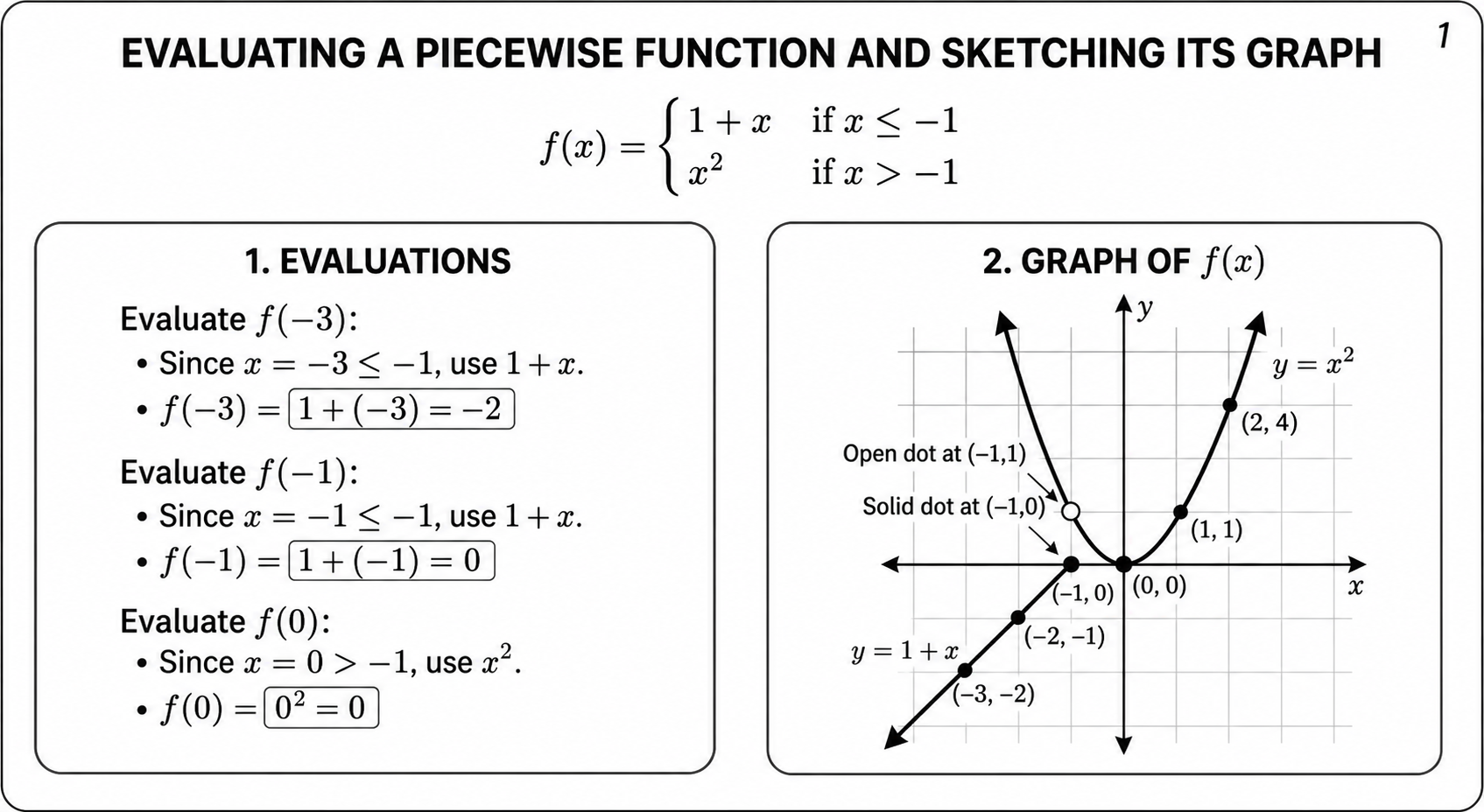
A piecewise function is a function defined by different expressions for different intervals of the domain.
Evaluating the function:
Given:
a) Finding :
Since , we use the first piece:
b) Finding :
Since , we use the first piece:
c) Finding :
Since , we use the second piece:
Sketch of the Graph:
Second Question
Discontinuity at a point occurs when a function is not continuous at that point, i.e., or the limit does not exist.
Types of Discontinuity:
Removable Discontinuity: The limit exists but is either not equal to or is not defined. The "hole" can be removed by redefining .
Jump Discontinuity: The left-hand limit and right-hand limit both exist but are not equal, i.e., .
Infinite Discontinuity: At least one of the one-sided limits tends to . This occurs at vertical asymptotes.
Analysing the given function:
Step 1: Factorize the denominator:
Step 2: Simplify the function:
Step 3: Identify points of discontinuity:
The function is undefined at and .
At (Removable Discontinuity):
The limit exists but is undefined. So this is a removable discontinuity.
At (Infinite Discontinuity):
The function tends to infinity, so this is an infinite discontinuity (vertical asymptote).
Conclusion:
The function is discontinuous at and . It is continuous for all , i.e., at every point except (removable) and (infinite).
Section B
Short Answers Questions