Semester
Subject
Year
Tribhuwan University
Institute of Science and Technology
2078
Bachelor Level / First Year / First Semester / Science
B.Sc in Computer Science and Information Technology (CSC116)
(Digital Logic)
Full Marks: 60
Pass Marks: 24
Time: 3 Hours
Candidates are required to give their answers in their own words as for as practicable.
The figures in the margin indicate full marks.
Section A
Long Answers Questions
Attempt any TWO questions.
[2*10=20]
1.
Design the sequential circuit with respect to the following state diagram using J-K Flip flops.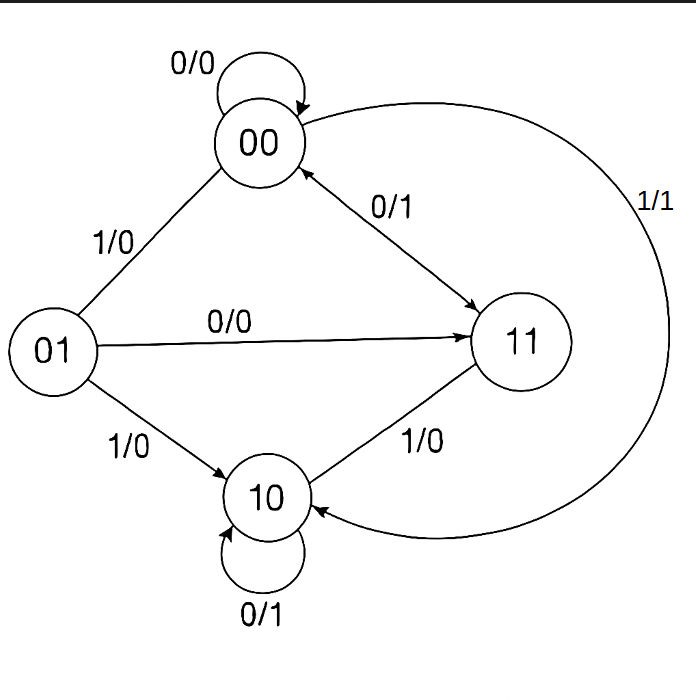 [10]
[10]
2.
Implement F using: a.Multiplexer
b. Decoderc. PLA[4+3+3]
3.
Differentiate between synchronous and asynchronous counter. Design mod-7 synchronous counter using T-flip flop. Show necessary truth tables and k-maps.[10]
Section B
Short Answers Questions
Attempt any Eight questions.
[8*5=40]
4.
Provide one example where shift right operation can be used. Explain parallel-in parallel-out register. [5]
5.
Carry out the following tasks: a. Perform 1's complement subtraction of 10101-100101 b. Represent decimal number 0.125 into its binary form [2.5+2.5]
6.
Derive the Boolean expression for sum and carry of half adder. Draw its combinational circuit. Implement it using only NAND gates. [5]
7.
Express the Boolean function F = x+yz as a product of max-terms. [5]
8.
Minimize the following Boolean function using K-map.
[5]
9.
What are the practical implications of up counter? Explain Binary ripple counter. [5]
10.
Design a combinational circuit with three inputs and one output. The output is 1 when the binary value of the inputs is an odd number. [5]
11.
Differentiate between PLA and PAL. Explain 4-bit magnitude comparator. [5]
12.
Write short notes on (Any Two):
[5]