Semester
Subject
Year
B.Sc Computer Science and Information Technology
Institute of Science and Technology, TU
Digital Logic (CSC116)
Year Asked: 2077, syllabus wise question
Binary Systems
1.
List two major characteristics of digital computer. Represent -6 (negative six) using 8 bits in signed magnitude, signed-1's-complement and signed-2's-complement respectively. Represent decimal number 4673 in a) octal, and b) BCD. [5]
Boolean algebra and Logic Gates
1.
Where is CMOS suitable to use? Define Power dissipation. Show that the positive logic NAND gate is a negative logic NOR gate and vice versa. [5]
Combinational Logic
1.
Design a combinatorial circuit that generates 9's complement of a BCD number. [10]
Combinational Logic with MSI and LSI
1.
Implement the following functions using PLA
[10]
2.
Design a full subtractor circuit with three inputs and two outputs Diff and . The circuit subtracts , where is the input borrow, is the output borrow, and Diff is the difference [5]
3.
Design 4-bit even parity generator. [5]
Registers and Counters
1.
What is the difference between a serial and parallel transfer? Explain how to convert serial data to parallel and parallel data to serial. What type of register is needed? [5]
2.
Explain negative-edge triggered D flip flop with necessary logic diagram and truth table. [5]
3.
Illustrate the use of Binary ripple counter and BCD ripple counter. [5]
Simplification of Boolean Functions
1.
Simplify the following function and implement them with two level NOR gate circuit, [5]
Synchronous and Asynchronous Sequential Logic
1.
Design sequential circuit specified by the following state diagram using T flip-flops. 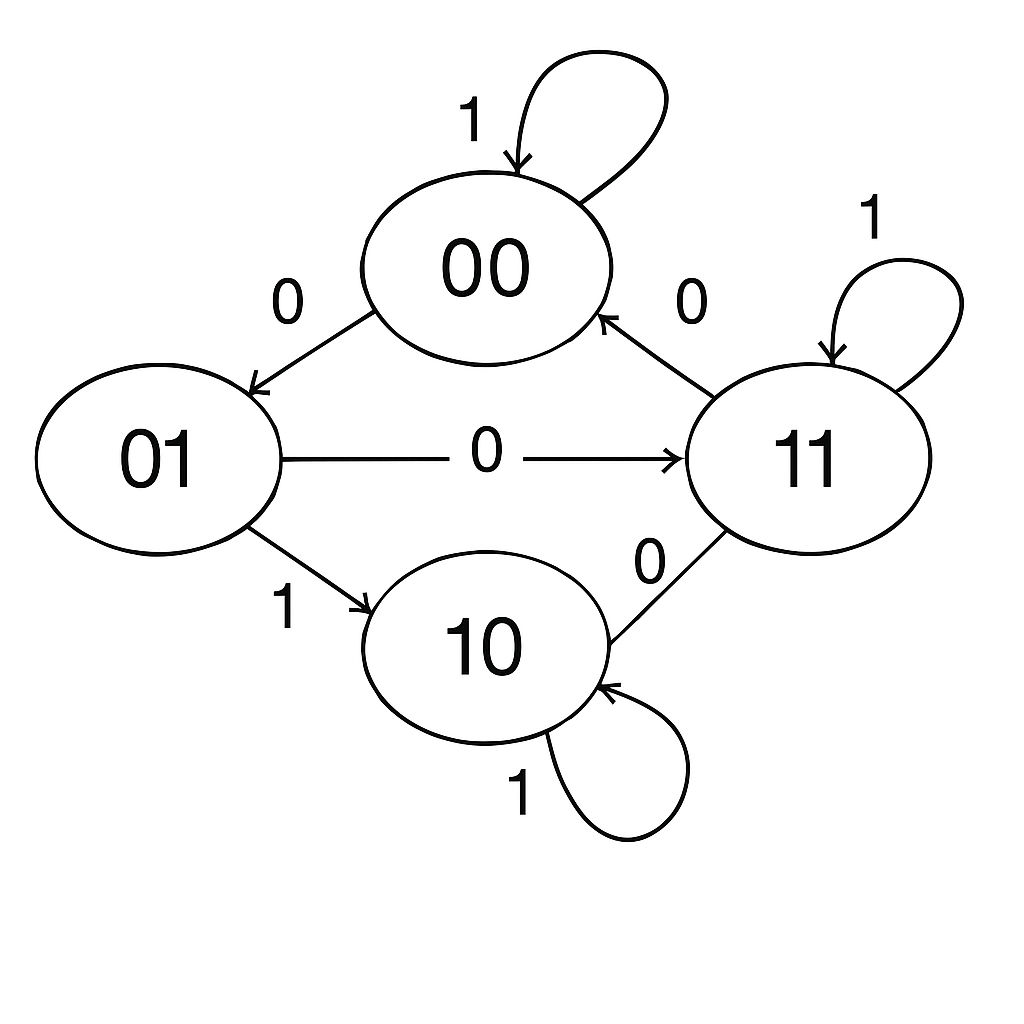 [10]
[10]
2.
Write short notes on (Any two):
[5]