Semester
Subject
Year
B.Sc Computer Science and Information Technology
Institute of Science and Technology, TU
Discrete Structures (CSC165)
Year Asked: 2080.1, syllabus wise question
Basic Discrete Structures
1.
Explain fuzzy set with example. How do you find complement of a fuzzy set? [5]
Counting and Discrete Probability
1.
What is product rule? How many strings are there of four lowercase letters that have the letter x in them? [5]
Induction and Recursion
1.
How can you use mathematical induction to prove statements? Use mathematical induction to show that sum of first n positive integer is [10]
2.
Explain linear homogeneous recurrence relation with constant coefficients. What is the solution of the recurrence relation , with initial conditions and ? [10]
Integers and Matrices
1.
Define function. Let and be function from R to R such that and . What are the functions and ? [5]
2.
What is congruent modulo? Determine whether 37 is congruent to 3 modulo 7 and whether -29 is congruent to 5 modulo 17. [5]
Logic and Proof Methods
1.
Give an example of tautology and contradiction. Show that implication and contrapositive are equivalence. [5]
2.
What is direct proof? Give a direct proof that if m and n are both perfect squares, then mn is also a perfect square. [5]
Relations and Graphs
1.
What is shortest path problem? Use Dijkstra's shortest path algorithm to find the shortest path between vertices a and z in the weighted graph below: 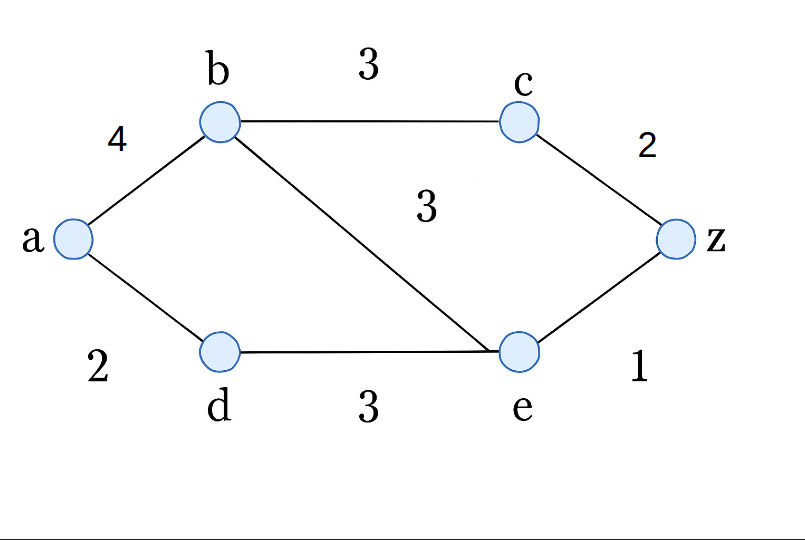 [10]
[10]
2.
Let us assume that R be a relation on the set of ordered pair of positive integers such that if and only if ad = bc. Is R an equivalence relation? [5]
3.
Define network flow with example. What are saturated edge, unsaturated edge and slack value? [5]
4.
Explain the matrix representation of relations with example. [5]